


What is On-Page SEO and Why Does it Matter?

If you’ve ever wondered why some websites appear at the top of search results while others seem invisible, the answer often comes down to search engine optimization (SEO). Within SEO, one of the most important elements is on-page SEO. This is the practice of optimizing the content and structure of individual web pages to improve rankings and attract more qualified visitors. Unlike off-page SEO, which deals with backlinks and external signals, on-page SEO is completely under your control.
In this article, we’ll break down what on-page SEO is, why it matters, and how you can apply best practices like meta tags, keyword optimization, and internal linking to your own website. By the end, you’ll understand not only the fundamentals but also how these pieces work together to help your site perform better in search results.
Understanding On-Page SEO
On-page SEO refers to all the techniques and strategies you apply directly on your website pages to make them more understandable and attractive to search engines. Search engines like Google want to deliver the most relevant and high-quality content to users. That means they look at signals such as:
- Page titles and descriptions
- Use of keywords within content
- Internal linking and website structure
- Heading hierarchy
- User experience factors like readability and speed
When you optimize these elements, you’re telling search engines exactly what your page is about and why it’s valuable. In turn, this helps your page rank higher when people search for topics related to your business.
Why Does On-Page SEO Matter?
Some business owners wonder whether on-page SEO is really worth the effort. After all, can’t you just create good content and let search engines figure it out? The truth is that even the best-written content can struggle if it doesn’t follow SEO best practices. Here’s why on-page SEO matters:
- Improved visibility: Optimized pages are more likely to appear in search results.
- Better user experience: Clear headings, structured content, and fast load times keep readers engaged.
- Higher click-through rates: Well-written titles and descriptions encourage more people to click.
- Stronger credibility: When your site ranks well, it signals authority to both users and search engines.
- More conversions: The right visitors find your pages, leading to more leads and sales.
In short, on-page SEO ensures your hard work in creating content actually pays off.
The Role of Meta Tags
Meta tags are snippets of text in your site’s HTML code that describe your page content. While users don’t usually see them on the page itself, search engines rely on them to understand what your content is about. The most important meta tags include:
Title Tags
Your title tag is what appears as the clickable headline in search results. It should accurately describe the page content while including your target keyword. For example, if you run a detailing shop in Missouri, a page about ceramic coatings might have a title like “Ceramic Coating Services in Washington, MO | Kelly Kleen Auto Detailing.”
Best practices for title tags include:
- Keep them under 60 characters.
- Place the main keyword near the beginning.
- Make them unique for each page.
Meta Descriptions
The meta description appears under the title in search results. It doesn’t directly impact rankings, but it does influence click-through rates. A strong description should be concise, persuasive, and contain the keyword naturally.
For example: “Protect your car’s paint and shine with professional ceramic coating in Washington, MO. Contact Kelly Kleen today.”
When writing descriptions:
- Keep them between 140–160 characters.
- Use action words like “discover,” “learn,” or “contact.”
- Clearly highlight benefits to the reader.
Other Meta Tags
There are additional meta tags like robots tags (which tell search engines whether to index a page) and canonical tags (which signal the preferred version of duplicate content). While less commonly edited by business owners, they play a role in ensuring search engines interpret your site correctly.
Keyword Optimization
Keywords are the words and phrases people type into Google. Optimizing your content around relevant keywords is central to on-page SEO. However, it’s not about stuffing the same phrase into every sentence—it’s about using keywords strategically and naturally.
Choosing the Right Keywords
Start with keyword research to identify the terms your potential customers are searching for. For example, if you run a small business in Franklin County, you might focus on terms like “web design in St. Louis” or “SEO services for contractors.” Long-tail keywords—longer, more specific phrases—are especially valuable because they often have less competition and higher intent.
Where to Use Keywords
Once you’ve identified your keywords, place them thoughtfully in:
- The title tag
- The first paragraph of content
- Subheadings (H2s and H3s)
- Image alt text
- Naturally throughout the body copy
For example, in our own article on how to create SEO service pages that rank, keyword placement plays a major role in making the content discoverable.
Avoiding Keyword Stuffing
Search engines are smart enough to detect when content is over-optimized. Repeating the same phrase unnaturally can harm rankings and make your content unreadable. Instead, use variations, synonyms, and related terms to keep the writing natural.
Internal Linking
Internal links are links that connect one page on your website to another. They play a crucial role in both SEO and user experience.
Benefits of Internal Linking
- Guides visitors: Internal links help readers find related content, keeping them on your site longer.
- Distributes authority: Links spread SEO value across your pages, boosting the overall site.
- Clarifies structure: They signal to search engines how your site is organized.
For example, if you’re reading about on-page SEO basics, it makes sense to also link to resources like our article on NAP consistency and local SEO. This keeps readers engaged while reinforcing related topics.
How to Use Internal Links Effectively
- Link to relevant pages that add value for the reader.
- Use descriptive anchor text (not just “click here”).
- Avoid overloading with too many links in a single section.
- Regularly review your site to add links to newer pages.
Internal linking is also an important strategy when troubleshooting issues, such as when your Google Business Profile isn’t appearing. Our article on why a Google Business Profile may not show up explains this in more detail and is a great example of how linking helps build a stronger SEO framework.
Heading Structure and Readability
Headings (H1, H2, H3, etc.) aren’t just for making text larger—they’re signals to search engines about the hierarchy of your content. They also make it easier for readers to skim and find what they need.
Best Practices for Headings
- Use a single H1 for the page title.
- Break content into logical sections with H2s.
- Use H3s or H4s for supporting details.
- Incorporate keywords naturally.
Beyond headings, readability is critical. Write in short paragraphs, use plain language, and include bullet points where they make sense. A page that’s easy to scan and understand will keep visitors engaged longer.
Page Speed and User Experience
On-page SEO goes beyond words and tags—it also includes the technical performance of your website. Search engines increasingly value user experience, and page speed is a major factor.
Why Speed Matters
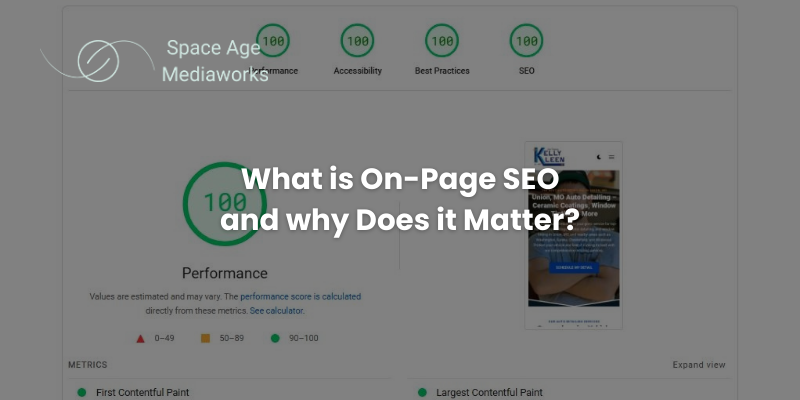
If your site takes more than a few seconds to load, visitors are likely to leave. Google knows this, which is why fast-loading pages are favored in rankings. Optimizing images, using efficient code, and leveraging proper hosting all contribute to faster sites. At Space Age Mediaworks, our hand-coded websites are built with speed in mind, consistently scoring perfect 100s on PageSpeed Insights.
Mobile Responsiveness
More than half of all searches happen on mobile devices. That means your site must be mobile-friendly. Responsive design ensures your site looks and functions well on any screen, improving both user experience and SEO.
Content Quality and Engagement
Ultimately, search engines rank pages that provide the most value to users. That means creating content that answers questions, provides solutions, and keeps readers engaged.
What Makes Content High Quality?
- Original insights that go beyond surface-level answers.
- Clear and actionable advice.
- Up-to-date information.
- Logical flow and structure.
For example, our article on Google Business Profile SEO tricks doesn’t just list generic advice—it provides real, actionable steps business owners can implement right away. That level of usefulness is exactly what both search engines and readers are looking for.
The Role of Engagement
High-quality content keeps visitors on your site longer, reduces bounce rates, and increases the chance they’ll explore other pages. Engagement signals indirectly support SEO by showing search engines that your site is trustworthy and worth ranking.
Bringing It All Together
On-page SEO isn’t about checking boxes—it’s about creating pages that are easy for both users and search engines to understand. Here’s how the main elements fit together:
- Meta tags explain what your page is about in search results.
- Keyword optimization ensures you’re targeting the right search intent.
- Internal links connect your pages and guide both users and search engines.
- Headings and readability improve comprehension and scanning.
- Speed and mobile optimization ensure a smooth user experience.
- High-quality content provides the real value that search engines want to promote.
When applied consistently, these techniques compound. Your site becomes more visible, your content attracts more clicks, and your business gains more opportunities to convert visitors into clients.
Final Thoughts: Why On-Page SEO Matters for Your Business
On-page SEO is one of the most direct ways to improve your online visibility. Unlike backlinks, which depend on other sites, on-page optimization is entirely within your control. It’s about making your website the best possible resource for both search engines and visitors.
By applying these strategies—crafting strong meta tags, placing keywords thoughtfully, linking internally, and delivering engaging content—you’ll position your site to climb higher in search results. And with that comes more qualified traffic, stronger credibility, and more opportunities to grow your business.
If you’re ready to take your website’s performance to the next level and want expert guidance on SEO, reach out today. Contact Space Age Mediaworks and let’s start building a site that actually works for your business.